Creating a Quiet Area in Classrooms
The school classroom can be a noisy and chaotic environment at the best of times.
This means children need a quiet area where they can concentrate on their work and cool off if they have been overly energetic.
You can give them such a space by introducing a quiet area in the classroom that boasts the right layout, visual cues and behavioural rules.
This will allow you to establish a quiet area away from the rest of the classroom where students can reflect and focus.
Below, we look at a few simple ideas that will allow you to establish a quiet area in the most hectic schoolroom.
Dedicate a Space
Ideally, the quiet space will be in a secluded or less-busy part of the room – that means away from the main desks, sinks and the classroom door.
The space should be of sufficient size to accommodate the number of students who need space to think, focus and generally calm down.
Having a dedicated space establishes not just the quiet area you are seeking to establish but helps set expectations, too.
The students will come to recognise that they must lower their voices in and around the space as it’s marked off from the rest of the classroom.
Define the Purpose
It’s important when establishing a quiet area to understand what you are looking to achieve.
Perhaps you want to give students a space to read, focus on math problems, or simply encourage them to calm down or reflect on their behaviour.
Again, by establishing the purpose you set expectations and students will come to understand what purpose the space is meant to serve and how to behave there.
Use Visual Cues
We all react to visual clues in public buildings, and students are no different.
The quiet space needs be recognised as such – and the easiest way of doing this is to give the students subtle or not-so-subtle cues that quiet is expected there.
This can be achieved in a few different ways:
- Using a different coloured rug
- Partitions or portable room dividers to physically carve out the space and establish it as a quiet area.
- Shelves can create a visual boundary.
- Signage or posters indicating that this is a quiet space.
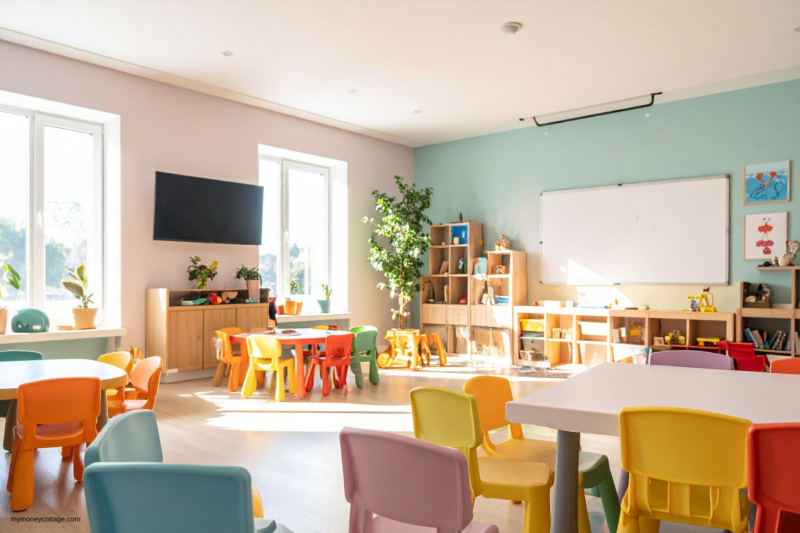
- Using soft colors and natural lighting if possible to make the space relaxing and inviting.
Use Tools
A quiet space should ideally be kitted out with the tools and devices that are known to be conducive to quiet and reflection.
This means you might use:
- Beanbags, cushions, low chairs, or small desks to encourage a more intimate and quiet classroom experience.
- Fidget tools, soft toys, and stress balls to distract emotional and energetic students and lower the volume.
- Age-appropriate books, workbooks, and quiet activities so students can be productive in the quiet area.
Get Feedback
Once you have set up your quiet space, the work continues.
By observing how students use the space and how they behave once installed there, you can then adjust the seating, introduce focus tools, or establish new rules if the quiet space isn’t having quite the effect you wanted.
Conclusion
Recent research into open-plan classrooms found that high levels of intrusive noise from nearby classes can negatively affect children’s learning and classroom performance.
Therefore, by creating quiet areas in classrooms you give students a place where they can not just think but thrive academically.