

Your Credit Score Explained in Simple Terms
If you’ve ever been refused credit, then you’ve probably heard about your credit score or credit rating. But you might not be sure what your score actually means. Hopefully this article will answer some of your questions and help to get your credit score explained in a way that helps you to understand what your current score means and how you can improve it.
Your Credit Score Explained
Your credit score is a three digit number that’s used to assess whether you’re suitable for a loan product. The number is based on your credit report.
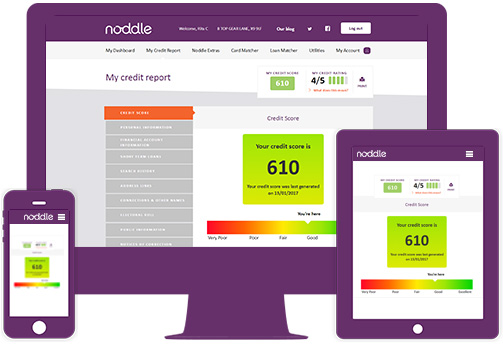
Every time you apply for a loan, credit card, finance, mortgage or any other financial product, a mark will be left on your credit report. All of your payments are recorded on your credit report, along with any financial relationships you have – think joint accounts, joint mortgages etc.
Where can you find your credit score?
There are a few different agencies in the UK that you can use to find out your credit score. I really recommend signing up to a free company such as Noddle and keeping a regular check on your score.
It’s important to know that your score will be different with different agencies, but the higher your score, the better your credit rating. Noddle’s maximum credit score is 710, so if you’re close to that, then you have a great credit score!
Experian are used frequently, but unlike Noddle, you can’t continue to access your file free of charge, they do charge after your free trial, so I’d recommend sticking with Noddle! Experian have a rating system from 0-999, with 999 being the highest possible credit score.
Equifax score from 0 – 700.
Why is your credit score different with different agencies?
There are three credit reference agencies in the UK – Experian, Equifax and Call Credit. Each agency has their own scoring method, but they’re all based on the same information so it doesn’t matter which agency you use.
Noddle use Call Credit, so their score will always be different to that of Experian or Equifax.
Noddle is the only free for life credit report that updates weekly, which means you can keep a really close eye on your credit rating without having to pay to see information about your own finances.
Your Credit Score Explained – What impacts your score?
There are lots of reasons why you might have a low credit rating, and if you’re able to figure out what they are, then you can start to make some changes and begin to improve your score.
Every time you apply for a credit product, a marker is left on your account, so applying for multiple products in a short space of time will have a negative impact on your score.
All of the payments you make will be recorded and any that are late or defaulted will be recorded too. Missed payments and defaults have a negative impact on your account, as do CCJS, insolvency and bankruptcies.
What does it mean if you have a low score?
With Noddle, you will have two different numbers showing on your account – your credit score and your credit rating.
Your credit rating is a number between 1 and 5 – the higher the number, the better your chances of being accepted for a new credit product. A credit rating of 1 means you are unlikely to be accepted for most products. You might find that you are eligible for high interest products because you’re seen as a high risk.
Your credit score is a number between 0 and 710, again, the higher the number, the better your score.
How can you improve your credit score?
- Don’t apply for multiple products in a short space of time.
- Pay your bills on time.
- Check your credit report regularly in case there are any errors.
- Try not to move house frequently.
- Make sure you’re not still linked to an ex who may have a poor credit rating.
- Make sure you are listed on the electoral register.
Your credit score explained – pin it for later.